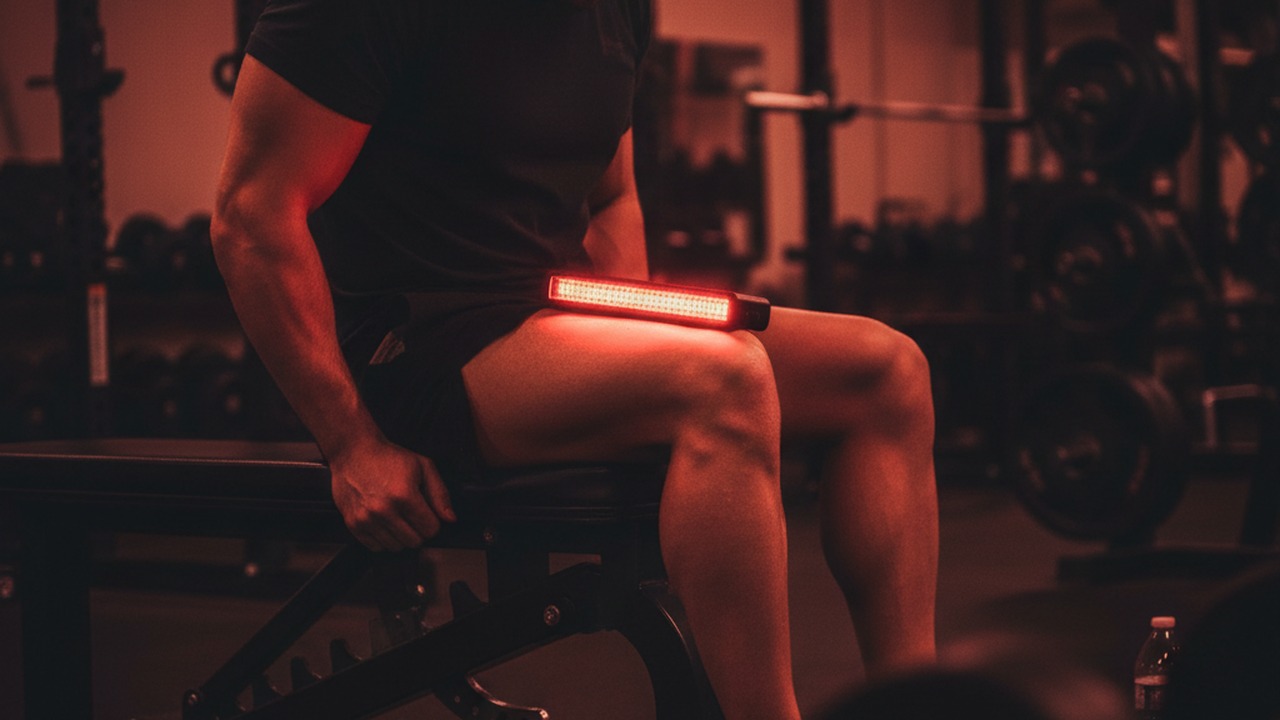
Red light panels are everywhere in gyms and physical therapy clinics now, but a new review published in Frontiers in Bioengineering and Biotechnology makes an uncomfortable point: most of the devices promising faster muscle recovery are being used at doses that have never been shown to work, and some are likely delivering too much light to help at all.
The paper, titled “Photobiomodulation for skeletal muscle regeneration: mechanisms, dosimetry, and translational challenges,” pulls together more than a decade of cell, animal, and human research on low-level light therapy. Its conclusion is not that red and near-infrared light fail to influence muscle repair. It is that the field has spent years chasing a therapy without agreeing on how much of it to give, to whom, or when.
What photobiomodulation actually does inside a muscle cell
Photobiomodulation works by shining light, typically in the 630 to 660 nanometer (red) or 810 to 850 nanometer (near-infrared) range, onto tissue. Those wavelengths penetrate skin and muscle deep enough to reach mitochondria, the organelles that generate cellular energy.
Inside the mitochondria, the light is absorbed by an enzyme called cytochrome c oxidase, part of the electron transport chain. Research tracing back to immunologist and PBM pioneer Michael Hamblin’s work at Massachusetts General Hospital has shown this absorption briefly displaces nitric oxide that has bound to the enzyme, temporarily restoring its efficiency and boosting ATP production.
That burst of cellular energy, paired with a carefully dosed increase in reactive oxygen species, appears to switch on signaling pathways tied to muscle repair. The new review ties this to activation of satellite cells, the resident stem cells responsible for regenerating damaged muscle fibers, along with upregulation of growth factors involved in angiogenesis and reduced inflammatory cytokine signaling in the hours after exercise-induced damage.
The dosing problem nobody talks about
Here is where the review gets more skeptical. Photobiomodulation follows what researchers call a biphasic dose response, sometimes referred to as the Arndt-Schulz law: too little light does nothing, an optimal window produces a measurable benefit, and too much light can blunt or even reverse the effect.
Commercial red light panels rarely disclose the irradiance reaching the skin, let alone the dose reaching muscle tissue several centimeters below it. Fluence, measured in joules per square centimeter, depends on wavelength, power density, distance from the skin, treatment duration, and even skin pigmentation, which absorbs and scatters light differently across individuals.
The authors argue that without reporting all of these variables, a study or a consumer device claiming a “red light therapy” effect is not describing a reproducible treatment. It is describing an unmeasured guess that happened to work, or didn’t, for reasons nobody can isolate afterward.
Why the animal data looks better than the human data
Much of the strongest evidence for photobiomodulation and muscle repair comes from rodent models, where researchers can control light dose precisely, biopsy muscle tissue on a schedule, and standardize the injury itself, often a crush or chemical lesion rather than the messier damage from real exercise.
Human studies, by contrast, have to work with intact skin and subcutaneous fat of varying thickness, exercise-induced damage that differs by individual and protocol, and devices that were not necessarily designed with dosimetry in mind. Earlier systematic reviews on light therapy and delayed-onset muscle soreness have found genuinely mixed results, with some trials showing meaningful reductions in soreness and strength loss and others showing no effect at all.
The new review frames this inconsistency as largely a reporting problem rather than evidence that the mechanism is fake. When trials are grouped by whether they used wavelengths and doses that match what cell and animal studies identified as effective, the human results look considerably more consistent. Trials that used arbitrary or underpowered doses tend to be the ones reporting null results.
What this means if you already use a red light panel
None of this means red light panels are useless, but it does mean two devices marketed identically can produce very different physiological doses at the muscle. A panel held 30 centimeters from the skin for ten minutes is not interchangeable with the same panel held at 10 centimeters for the same duration.
The review’s practical takeaway for consumer use leans on the irradiance and wavelength specifications that credible manufacturers publish, and on timing sessions close to the actual muscle tissue rather than through thick clothing or at a distance that drops the dose below the effective threshold. Reviews of specific consumer panels, including the Hooga Pro and the Joovv Solo 3.0, are useful partly because they report measured irradiance at specific distances rather than relying on marketing claims alone.
Timing relative to exercise also matters more than most marketing suggests. Some of the clearer human trials cited in the broader literature applied light before exercise to precondition muscle, rather than purely as a post-workout recovery tool, a nuance that most at-home routines ignore entirely.
The translational gap the paper is really about
The review’s title specifically flags “translational challenges,” researcher shorthand for the gap between a mechanism that works cleanly in a petri dish or a mouse and a therapy that reliably works in a clinic or a living room. For photobiomodulation, that gap is unusually wide because the same intervention, light, behaves completely differently depending on tissue depth, pigmentation, and device design.
The authors call for standardized reporting of irradiance, wavelength, pulse structure, and total energy delivered in every future trial, mirroring the dosing rigor applied to pharmaceuticals. Without that, they argue, the field will keep generating studies that cannot be compared to one another, let alone replicated by someone buying a panel off a shelf.
That is a less exciting headline than “red light cures muscle soreness,” but it is a more useful one. The mechanism behind photobiomodulation is grounded in real mitochondrial biology, not a wellness trend built on nothing. The question the field still has not answered is not whether light can influence muscle repair, but which exact dose, wavelength, and timing combination will do it on command.