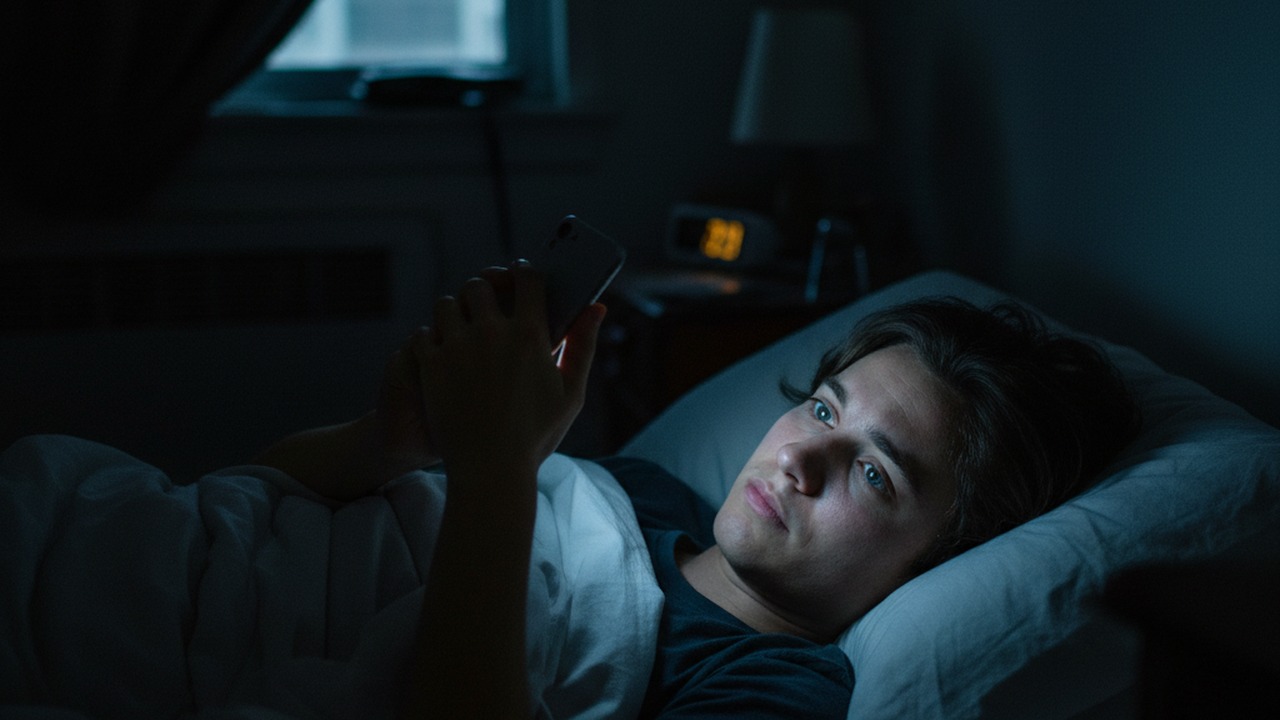
Insomnia has long been treated as a footnote in ADHD research, a side effect of a mind that can’t power down at bedtime. New findings on adults with ADHD suggest that framing has it backwards.
The strongest predictor of sleepless nights wasn’t inattention or hyperactivity. It was how poorly someone managed their emotions during the day, and how few tools they had to bring themselves back down once upset.
The symptom that never made the official checklist
ADHD is diagnosed on inattention and hyperactivity-impulsivity. Emotional regulation has never been part of the formal criteria, even though clinicians who treat adults with the condition have argued for years that it should be.
Russell Barkley, a clinical professor of psychiatry at Virginia Commonwealth University Medical Center, has spent much of his career making that case. He describes what he calls deficient emotional self-regulation: a reduced ability to inhibit strong feelings, redirect attention away from them, and calm the body back down after they hit.
That deficit doesn’t show up only in arguments or moments of frustration. It shows up at 11 p.m., when the lights are off and there’s nothing left to distract from whatever emotional residue the day left behind.
Why bedtime is where dysregulation surfaces
Falling asleep requires a specific kind of quiet: a nervous system that can downshift out of alertness. For someone who struggled to process a stressful email, an awkward conversation, or a wave of frustration hours earlier, that downshift doesn’t come easily.
Unprocessed emotion tends to resurface the moment external stimulation disappears. Racing thoughts, replaying conversations, and a wired-but-tired feeling at bedtime are all consistent with a nervous system still running on the arousal generated by emotions that were never fully metabolized.
This is distinct from classic ADHD-related sleep complaints like delayed circadian rhythm or difficulty winding down from stimulation. It’s an emotional hangover with nowhere left to go once the lights go out.
Coping strategies are the missing variable
The people most likely to struggle with sleep weren’t necessarily those with the most intense emotions. They were the ones with the thinnest toolkit for managing those emotions once they arrived.
Effective emotional coping includes skills like cognitive reappraisal (reframing a stressful event), acceptance (letting a feeling pass without fighting it), and problem-focused coping (addressing the source of distress directly). Adults with ADHD frequently default instead to avoidance, rumination, or suppression, strategies that are efficient in the short term and costly at 2 a.m.
That distinction matters clinically. It suggests insomnia in this population isn’t simply downstream of attention or hyperactivity symptoms. It’s downstream of what happens, or fails to happen, in the hours after an emotional spike.
Young adults are carrying the heaviest load
The link between emotional dysregulation and insomnia was strongest in young adults, a group already navigating a uniquely destabilizing stretch of life. The early twenties bring irregular schedules, first jobs, relationship instability, and a prefrontal cortex that isn’t done maturing, all layered on top of ADHD’s existing regulation challenges.
Younger adults with ADHD also tend to have had less time to build coping infrastructure: fewer years of therapy, fewer trial-and-error lessons about what calms them down, and often less stable routines than older adults with the same diagnosis. That gap in accumulated skill may explain why the emotional-insomnia connection shows up most sharply in this age group.
It’s a pattern with real consequences. Poor sleep degrades exactly the executive functions, impulse control, working memory, emotional regulation, that were already strained to begin with, creating a feedback loop that’s hard to break without outside intervention.
What this means for treatment
Standard insomnia advice, dim the lights, skip the late caffeine, keep a consistent wake time, isn’t wrong, but it’s incomplete for this population. If the sleeplessness originates in unresolved emotional arousal, sleep hygiene alone won’t touch the root cause.
Clinicians who treat adult ADHD increasingly point to interventions that build emotional regulation skills directly, such as dialectical behavior therapy techniques adapted for ADHD, or cognitive behavioral therapy for insomnia that also addresses daytime emotional processing. The goal isn’t just a better bedtime routine. It’s giving someone a way to actually finish processing the day before trying to sleep through it.
Mary Solanto, a psychologist who has published extensively on cognitive-behavioral approaches to adult ADHD, has long argued that treatment plans built solely around attention and organization miss a large piece of what actually impairs daily functioning. Sleep may be the clearest evidence yet of what gets missed when emotional regulation is treated as an afterthought.
The bigger picture
None of this means every restless night in someone with ADHD traces back to an unprocessed emotion. But it does reframe a symptom that’s often dismissed as incidental.
Insomnia in ADHD isn’t just a scheduling problem or a stimulant side effect. For a meaningful number of adults, especially the young adults this pattern hit hardest, it may be the nervous system’s way of finishing a job that never got closed out during the day.