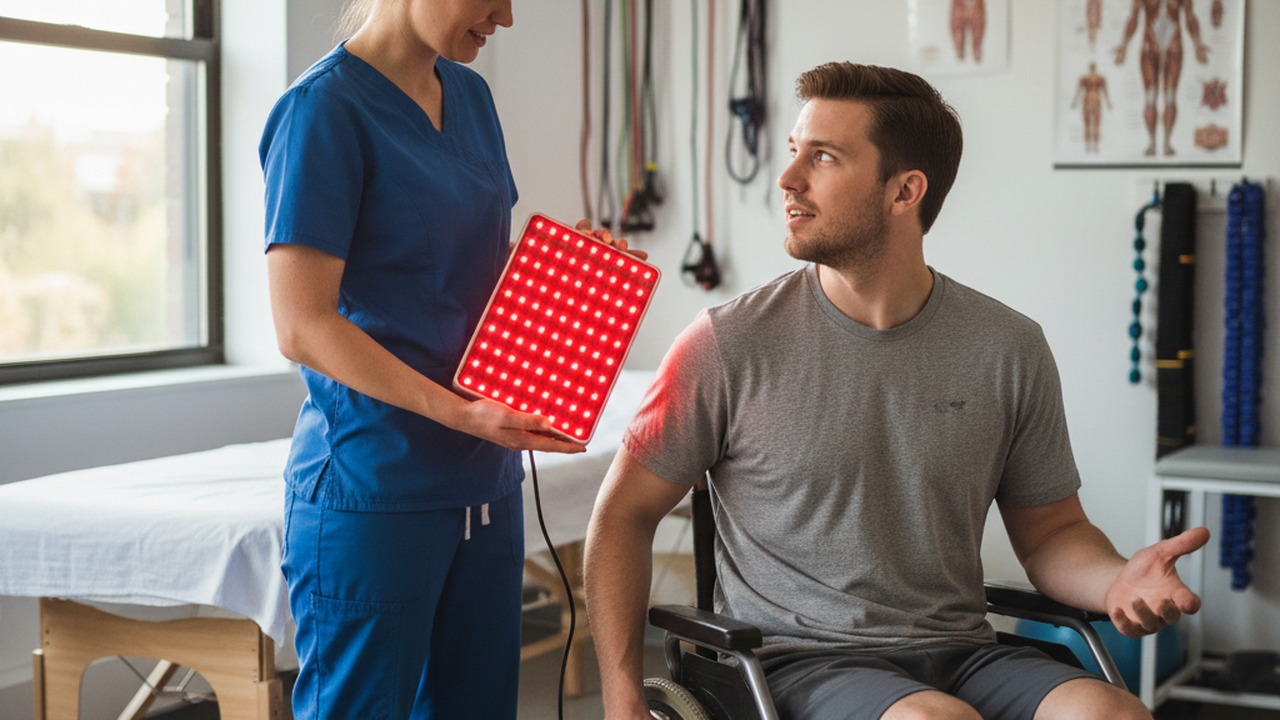
A single LED panel, the kind marketed for acne or sore knees, is now being tested for something far more ambitious: coaxing a damaged spinal cord back toward function. A review published in Experimental Neurology in October 2026 lays out where that research actually stands, and it is further along than most people assume.
The therapy is called photobiomodulation, or PBM: the use of specific wavelengths of red and near-infrared light to change how cells behave, without generating enough heat to damage tissue. It has been studied for wound healing and muscle recovery for decades. Spinal cord injury is a newer, much harder target.
What the light is actually doing inside a cell
Red and near-infrared wavelengths, roughly 600 to 1000 nanometers, penetrate tissue and get absorbed by a mitochondrial enzyme called cytochrome c oxidase. That absorption briefly boosts the mitochondria’s output of ATP, the molecule cells use as energy currency.
The effect cascades from there. Cells exposed to the right dose of light show altered calcium signaling, changes in reactive oxygen species, and activation of transcription factors tied to cell survival and repair. None of this is exotic biology. It is the same mitochondrial photochemistry researchers like Tiina Karu described in low-level laser studies going back to the 1980s, now being pointed at a much more difficult problem than a slow-healing wound.
Why the spinal cord fights back so hard
A spinal cord injury rarely stops doing damage at the moment of impact. The initial mechanical trauma triggers a secondary injury cascade that can last days to weeks: swelling, oxidative stress, immune cell infiltration, and programmed cell death that kills neurons well outside the original injury site.
That secondary phase is where photobiomodulation is aimed. The theory, laid out across the preclinical literature the Experimental Neurology review synthesizes, is that light delivered in the hours and days after injury can blunt this cascade, limiting how much additional tissue is lost and creating conditions that are friendlier to axonal regrowth.
What animal research has shown
Juanita Anders, a neuroscientist at the Uniformed Services University who has studied near-infrared light in spinal cord injury models for more than fifteen years, has published some of the field’s foundational work. Her group and others have reported that rodents treated with near-infrared light after spinal cord injury show smaller lesion cavities, reduced markers of inflammation, and measurably better locomotor recovery on standardized scoring scales compared with untreated animals.
Other rodent studies have found increased axonal sprouting across the injury site and fewer signs of the scar tissue that normally blocks regenerating nerve fibers from reconnecting. The effect sizes vary considerably depending on wavelength, dose, and how soon after injury treatment begins, which is exactly the kind of variability a synthesis review like this one is meant to sort through.
The jump from rats to people is the hard part
Light penetration is the practical obstacle nobody gets around easily. The spinal cord sits behind bone, muscle, and several centimeters of soft tissue in a way that a rat’s much smaller body does not replicate.
Getting a therapeutic dose of light to actually reach spinal cord tissue in an adult human, without simply heating the skin, is an engineering problem as much as a biological one. Some research groups are testing higher-powered laser diodes and longer wavelengths that penetrate deeper; others are exploring implantable or intraoperative delivery for cases where the spine is already surgically exposed. Human trials remain small, early-phase, and mostly focused on safety rather than proving functional recovery.
This is not the same as a home red light panel
Consumer red light devices, like the ones covered in Athletic Insight’s Hooga Pro panel review or our guide to the best red light therapy for knee pain, work on the same underlying mitochondrial mechanism. But they are built for shallow targets: skin, joints, and superficial muscle, not a structure buried deep in the spinal column.
The doses, wavelengths, and delivery methods being tested for spinal cord injury are clinical protocols developed for a specific, severe condition under research supervision. Nobody in this field is suggesting a wellness panel bought online can reach or repair spinal cord tissue.
Where this is realistically headed
The review frames photobiomodulation as one piece of a combination approach rather than a standalone fix. Researchers are increasingly testing it alongside stem cell transplantation, physical rehabilitation, and pharmacological agents, on the logic that a therapy which improves the local tissue environment might make other interventions work better rather than replacing them outright.
Spinal cord injury has resisted single-intervention solutions for decades, and there is no indication light is about to be the exception. What the research does suggest is that a technology once dismissed as too simple to matter is now earning a serious look from labs working on one of neuroscience’s hardest problems.