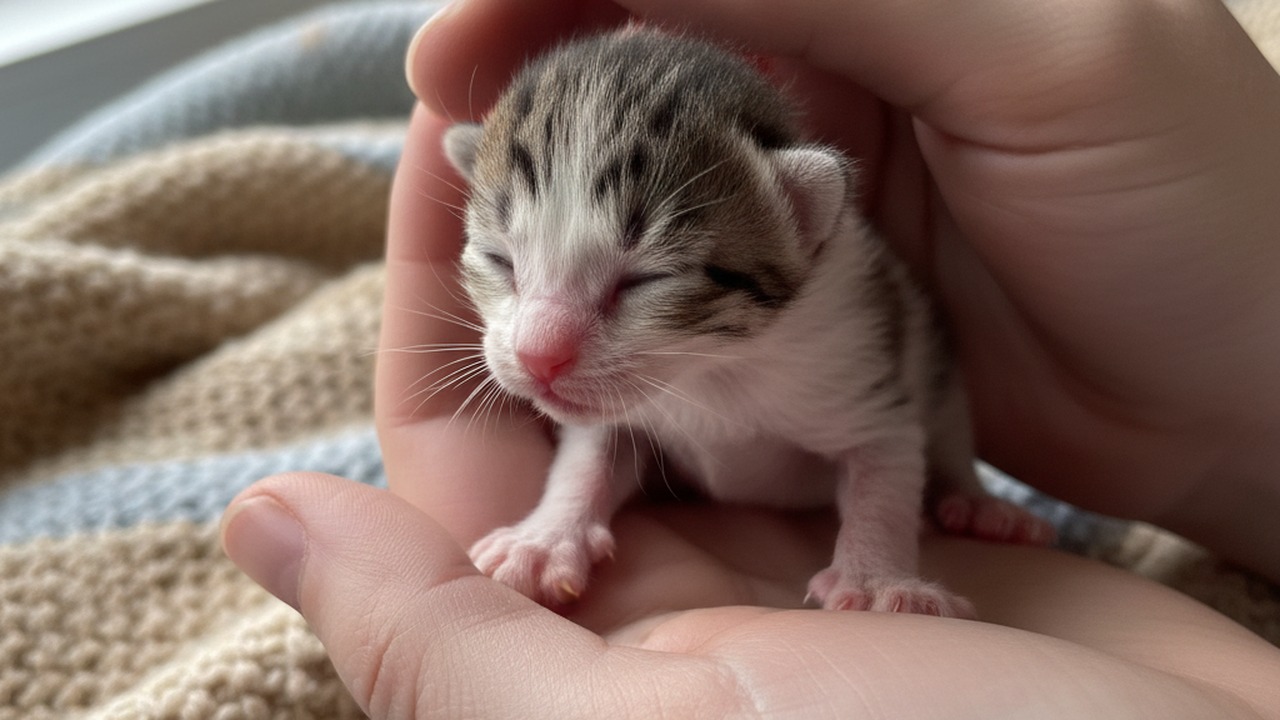
A newborn kitten can shake so hard it looks like a seizure. In most litters, that tremor is not a symptom of anything wrong. It is the visible evidence of a nervous system that has not finished wiring itself.
Kittens Are Born Unfinished
Cats belong to a group of mammals born altricial, meaning helpless and underdeveloped compared with species like foals or calves that stand and walk within hours of birth. A newborn kitten cannot regulate its own body temperature, cannot see or hear reliably, and cannot coordinate its own limbs.
That last part is what produces the tremor. The muscles are there, but the wiring that controls them is still under construction, and that wiring finishes on its own schedule regardless of how alert or well fed the kitten is.
The Missing Insulation Behind the Shakes
Nerve fibers carry electrical signals from the brain to the muscles, and in adult animals those fibers are wrapped in myelin, a fatty sheath that speeds up transmission and keeps the signal clean. At birth, a kitten’s nervous system has very little of this insulation in place.
Without it, signals travel slower and less precisely, and the result looks like trembling, twitching, or jerky, uncoordinated movement. Myelination continues for several weeks after birth, which is why the shaking of a two day old kitten is dramatically different from the steadier, more controlled movement of a three week old one.
The process is not unique to cats. It is the same basic mechanism that makes a human infant’s movements look jerky and reflexive before smoothing out over the first year of life.
Weak Muscle Tone Comes First, Coordination Comes Later
Veterinary references on feline neonatal development, including guidance published by Cornell University’s Feline Health Center, describe newborn kittens as having minimal muscle tone for roughly the first two weeks of life. They cannot fully support their own body weight, and their early attempts to move look more like paddling than walking.
The righting reflex, the ability to flip onto their feet when placed on their back, typically emerges within the first one to two weeks. Standing and deliberate walking follow around the third week, and by four to five weeks most kittens are running, pouncing, and play fighting with littermates.
The trembling is a checkpoint along that timeline, not a detour from it. A kitten that seems shaky at day three and steady at day twenty one is not recovering from anything; it is simply further along the same developmental curve.
Vision and Hearing Are Running the Same Delay
The nervous system’s slow rollout is not limited to muscle control. Kittens are born with their eyes sealed shut, and they typically open somewhere between seven and fourteen days of age, though the vision behind them stays blurry and light-sensitive for weeks afterward.
Ear canals open on a similar timeline, but functional hearing, the ability to localize where a sound came from, develops even later. A kitten that seems startled, unresponsive, or oddly focused on nothing in particular in its first two weeks is not showing a deficit; its senses simply have not finished coming online yet.
Cold Makes It Worse, But Cold Is Not the Only Cause
Thermoregulation is one of the last systems to mature in a newborn kitten. For the first couple of weeks, kittens cannot shiver effectively to generate their own body heat, so they depend on their mother, littermates, and a warm environment to stay within a safe temperature range.
A cold kitten will tremble too, which is why owners often assume every shake means the kitten needs warming up. The distinction matters less for immediate care, since a warm, dry, well fed kitten covers both bases, and more for understanding that a kitten can be perfectly warm and still tremble simply because its nervous system is not finished.
What Actually Warrants Concern
Trembling on its own, in a kitten that is otherwise nursing, warm to the touch, and gaining weight day over day, is not a red flag. What veterinarians do flag is trembling combined with other signs: a kitten that feels cold and limp, refuses to nurse, cries persistently, or becomes unresponsive to handling.
Those combinations point toward more serious issues such as hypoglycemia or what is broadly termed fading kitten syndrome, where a newborn’s condition declines rapidly in the first days of life. Daily weight checks are the simplest early warning system breeders and foster caregivers rely on, since a kitten steadily gaining weight is almost always a kitten developing on schedule, tremor and all.
The Same Immaturity Explains the Sexing Mix-Ups
The same underdeveloped state that produces the tremor is also why guessing a young kitten’s sex is notoriously unreliable, even for people who have raised litters for years. In both male and female kittens, the genital area looks similar at a glance: two small openings positioned close together beneath the tail.
The most consistent visual cue is the distance between the anus and the genital opening. Males typically show a wider gap, with the overall shape resembling a colon, while in females the two openings sit closer together, resembling an exclamation point.
Even that distinction is subtle at one to two weeks old, before the fur has fully filled in and before a male’s testicles descend, which usually happens around six to eight weeks of age. Veterinary staff routinely revise sex determinations made in the first days of life once a kitten is a bit older, which is exactly the kind of correction litter caretakers on social media report after posting early photos.
A Fast, Compressed Timeline
The wobbling, trembling, barely mobile kitten of week one is not a preview of a fragile adult cat. It is the starting point of one of the fastest developmental sprints in mammalian life, one that takes a blind, deaf, unsteady newborn to a fully coordinated, climbing, hunting animal in a matter of weeks.
The shaking is not the exception to that process. It is what that process looks like from the outside while it is still happening.