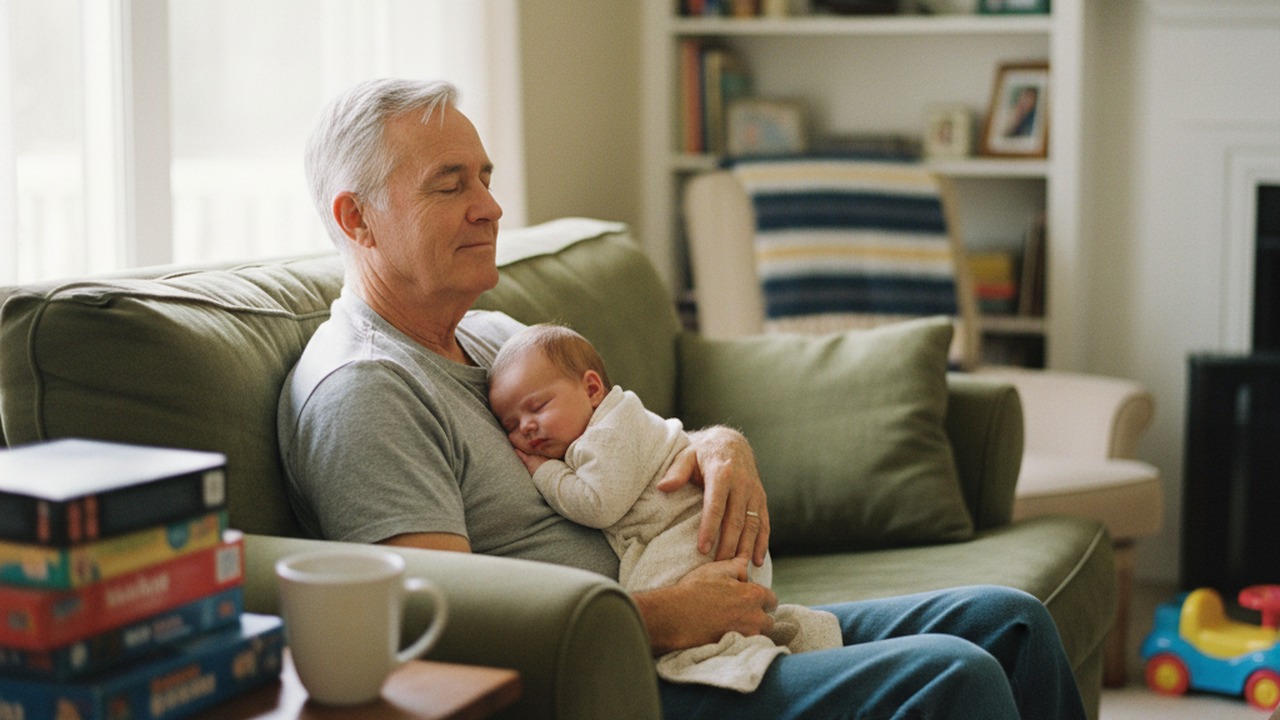
A man’s testosterone drops by roughly a quarter in the years after he becomes a father, and the men who do the most hands-on caregiving see the steepest declines. That finding, from a nine-year study of nearly 700 men in the Philippines, helps explain something millions of adult children eventually notice on their own: the father who seemed distant or hard to read in childhood often becomes visibly softer, warmer, and more openly affectionate once he becomes a grandfather.
Long before any of that is measurable in a lab, it usually shows up first as a feeling. A grown child sits with an old memory and realizes it looks different now than it did at the time.
The shift is not just sentimental. It shows up in blood chemistry, in brain activity, and in psychological research on how people make sense of their own life stories decades after the fact.
What actually changes in a father’s body
The clearest evidence comes from a 2011 study published in the Proceedings of the National Academy of Sciences by anthropologist Lee Gettler and colleagues, then at Northwestern University. The researchers tracked testosterone levels in young men before and after they became fathers.
Single, childless men in the study kept stable or slightly rising testosterone over the study period. Men who became fathers saw their levels fall substantially, and fathers who spent three or more hours a day in direct childcare, feeding, soothing, playing, showed the largest drops of all.
Testosterone is linked to competitive and mate-seeking behavior. Lower levels are associated with more nurturing, patient, protective responses, the kind of steady presence a demanding job or a young family rarely lets a man show consistently.
That decline does not reverse itself once children grow up. It continues gradually as men age, which means many grandfathers are working with a different hormonal baseline than the one they had as harried thirty-something dads.
Grandparenthood adds a second shift
Becoming a grandparent appears to layer a further change on top of that. Researchers who study caregiving hormones have found that oxytocin, the neuropeptide associated with bonding, trust, and affection, rises in response to close contact with infants and young children, and grandparents are not exempt from that response simply because the child is not their own.
Unlike new parents, grandparents typically experience this bonding without the sleep deprivation, financial pressure, or full-time responsibility that blunts emotional availability in the early years of raising a child. A grandfather can hold a crying baby for twenty minutes and hand the baby back.
A father holding his own crying baby at 3 a.m., worried about his job and his marriage, is operating under a very different kind of load. Psychologists who study parental stress note that chronic stress narrows emotional expression generally, and that a father managing his own physical or mental health struggles has even less bandwidth left over for open affection, even when the underlying love is just as strong.
A grandfather also carries less of the disciplinary weight parents have to hold. He does not have to enforce bedtimes, manage tantrums at the grocery store, or be the one saying no all day, so there is simply more emotional room left for saying yes.
Why adult children only see it later
There is also a purely cognitive piece to this, separate from anything happening in a father’s hormones. Psychologist Dan McAdams, who studies narrative identity at Northwestern University, has spent decades documenting how people revise the stories they tell about their own lives as they gain distance from the events.
Children experience a parent’s behavior directly and immediately: a father who worked constantly, who struggled with his health, who did not say much, simply registers as absent or hard to reach. Adults, looking back with more context, often reinterpret the same behavior as evidence of effort under difficult circumstances.
This is sometimes called a redemptive narrative, a life-story pattern in which early hardship gets reframed as the setup for later meaning rather than simple loss. It is one reason a childhood memory that felt neutral or even painful at age eight can feel like proof of quiet devotion at age thirty-five, once the adult child has enough life experience to recognize what effort under strain actually looks like.
None of this requires the father to have changed his story. It requires the child to have grown enough perspective to read the same events differently.
The role of a hard childhood specifically
Mental and physical health struggles complicate this picture in a specific way. A father managing chronic illness, depression, or anxiety while raising children is not choosing distance, he is often operating with a genuinely smaller reserve of energy and emotional regulation to draw on.
Research on parental depression consistently finds it is associated with reduced warmth and responsiveness in day-to-day interactions, not because love is absent but because the physiological and cognitive resources needed to express it are depleted. Children raised in that environment frequently internalize the withdrawal as rejection, since young children lack the framework to separate a parent’s illness from a parent’s feelings toward them.
Decades later, with a fuller picture of what that parent was carrying, many adult children arrive at a more accurate read: the father was fighting a battle the child could not see, and showing up anyway was the love, even if it did not look like the affection other families displayed.
What this means for families now
None of this is an argument that emotional distance in fathers is fine as long as it gets explained later. Children benefit from warmth in real time, and researchers who study attachment are clear that consistent early responsiveness shapes a child’s sense of security in ways a warmer grandfather years later cannot fully retroactively fix.
But it does offer a useful reframe for adult children sitting with complicated memories of a father who struggled. The biology of fatherhood is not fixed at one setting for a man’s entire life, and a father who could not show up the way he wanted to at thirty may be fully capable of it at sixty, not because he suddenly started caring more, but because the hormonal, situational, and cognitive conditions that once made warmth harder to access have genuinely shifted.
For men currently in the thick of early fatherhood, particularly those managing their own health challenges, the research offers a quieter reassurance. The capacity for visible tenderness is not gone if it is not showing up on schedule, and it is worth telling a struggling father directly that the effort is visible even when the affection is not yet obvious.
For many men, it is still building, waiting for a body and a life with more room to let it out.