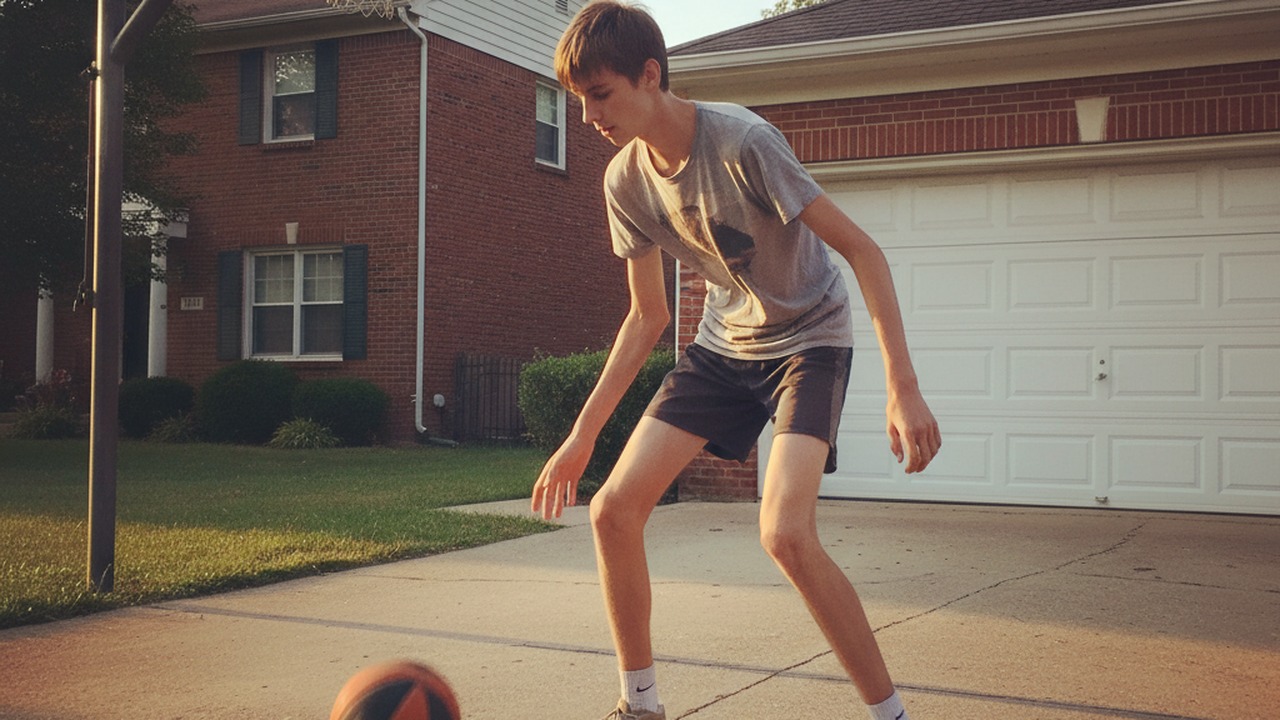
A child who shoots up several inches in a single growth spurt is not automatically getting stronger. In a growing body of pediatric bone research, tall children who stay sedentary end up with muscles and bones that lag disproportionately behind their height, a gap that has nothing to do with genetics and everything to do with mechanical load.
Height outpaces strength before sports ever enters the picture
Bone and muscle do not grow on the same schedule as the skeleton’s length. During a growth spurt, long bones lengthen quickly, but the muscle mass and mechanical loading needed to build proportional bone strength take longer to catch up.
Pediatric bone researchers describe this as a lag in the functional muscle-bone unit, a concept developed by Eckhard Schoenau, a pediatric bone specialist at the University of Cologne. His work argues that bone strength should track the force muscles place on it, not simply a child’s age or height.
In a tall, inactive child, that unit falls out of balance. The skeleton has grown to support a bigger frame, but without the muscle loading that normally comes from running, jumping, and changing direction, bone mineral accrual does not keep pace.
Why longer bones need more force, not less
Longer limbs act as longer levers. A taller child’s bones experience more bending stress for the same movement than a shorter child’s bones do, so they need proportionally more muscle force just to stay strong.
The physiologist Harold Frost, who first described bone’s mechanostat theory, showed that bone tissue adds or removes mineral in direct response to the mechanical strain it experiences. Bone that is not loaded above a certain threshold is treated by the body as unnecessary weight, and it is not reinforced.
For a tall child sitting through screen time instead of soccer practice, that threshold is rarely met. The result is a skeleton that looks fully grown on a height chart but is thinner and weaker at the tissue level than it should be.
What a full reversal actually looks like
The encouraging part of this research is how completely the deficit closes once regular sport is introduced. Weight-bearing, high-impact activities like basketball, soccer, and gymnastics deliver the repeated mechanical strain that triggers bone formation and stimulates the muscle growth needed to support a taller frame.
Researchers who have tracked bone accrual across adolescence, including the long-running Saskatchewan Pediatric Bone Mineral Accrual Study led by Donald Bailey at the University of Saskatchewan, have repeatedly found that active children build significantly more peak bone mass during the growth spurt years than inactive peers, regardless of starting height.
Once a formerly sedentary tall child takes up a sport consistently, muscle cross-sectional area and bone mineral density climb together. Within roughly a year of regular training, the disproportionate weakness tied to their height tends to disappear, bringing their muscle and bone strength back in line with what their frame should support.
Why tall kids get pulled out of activity in the first place
Ironically, height is often the reason a child stops moving rather than the reason they excel at sport. Tall children are frequently clumsier during rapid growth spurts, a stage researchers refer to as adolescent awkwardness, caused by limbs lengthening faster than the nervous system can recalibrate coordination.
That temporary clumsiness can be embarrassing enough to push a child away from team sports at exactly the point when their bones need loading the most. Parents and coaches sometimes misread this stage as a lack of athletic ability rather than a normal, short-lived phase of neuromuscular catch-up.
There is also a social pattern worth naming: tall kids are frequently assumed to be naturally strong and pushed toward sports without any training base, then quietly drop out when they struggle, missing the loading window a shorter, less conspicuous peer might get through a more forgiving beginner league.
The peak bone mass window does not stay open
Around 90 percent of adult peak bone mass is laid down by the end of adolescence, which means the muscle-bone deficit seen in tall, inactive children is not just a childhood inconvenience. Bone accrued during these years forms the mineral bank a person draws on for the rest of their life, including the decades when age-related bone loss accelerates.
A child who exits adolescence with a bone deficit tied to inactivity, rather than genetics, starts adulthood with less reserve before osteopenia becomes a clinical concern. That is part of why researchers in this field frame regular sport participation during growth spurts as a preventive measure, not just a fitness recommendation.
What this means for parents of a fast-growing kid
The practical signal from this research is straightforward: a height percentile on its own says nothing about muscle or bone strength, and it should not be treated as a proxy for readiness or robustness. A tall child who is not playing a sport is not simply less athletic by choice, they may be missing mechanical loading their bones specifically need at that stage of growth.
Weight-bearing, multidirectional activities do the most work here. Running, jumping sports, and resistance-style training that load bone through impact and muscle tension outperform swimming or cycling for this specific purpose, since low-impact activities do not deliver the same strain signal to bone tissue.
Consistency matters more than intensity. The research points to sustained participation across a growth spurt, not a single season, as the factor that closes the gap between a tall frame and the muscle and bone strength needed to support it.
The takeaway
Being tall is not a shortcut to being strong, and for a child who is not moving, it can quietly work the other way. The fix is not complicated or expensive: regular sport, sustained through the growth spurt years, appears to fully close a gap that inactivity opens and that height alone will never fill.