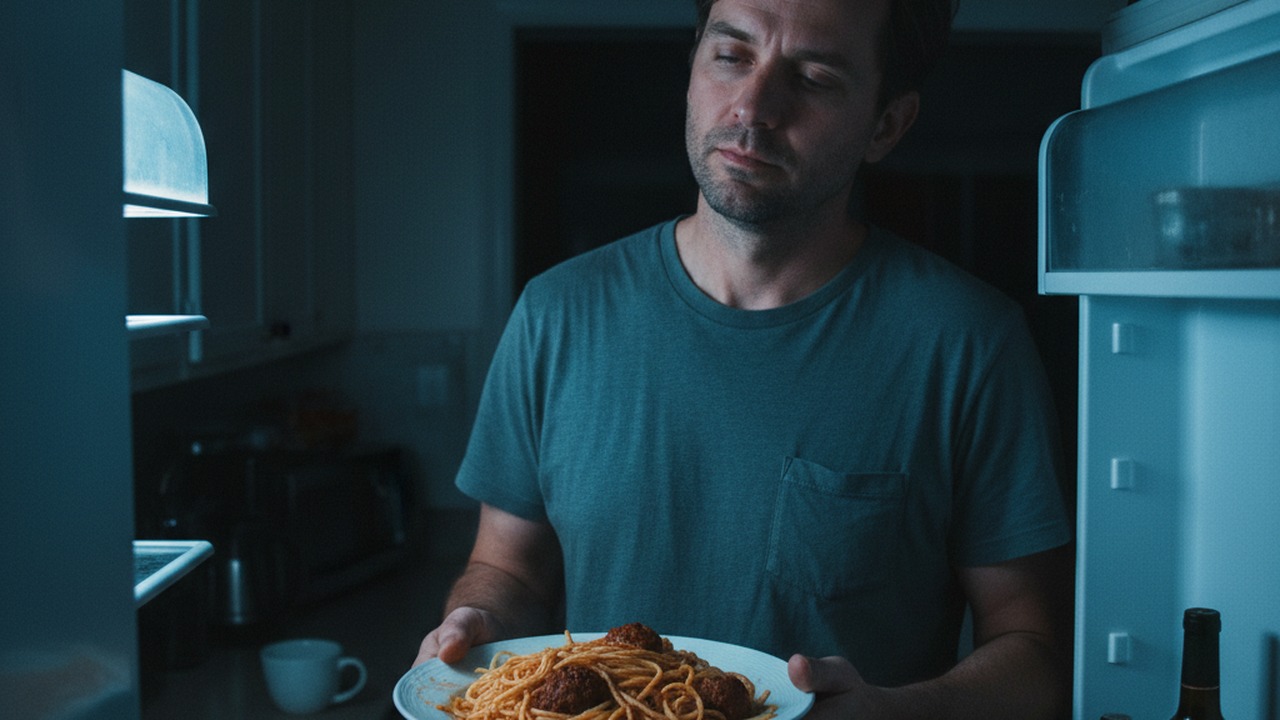
People who stay up late do not just sleep differently than early risers. They eat differently, and the pattern is quietly reshaping their metabolic health.
Researchers tracking dietary intake by chronotype found that self-identified night owls consistently took in less energy and less protein during the morning hours. Later in the day, the same group shifted toward foods dense in energy, carbohydrates, and fat, with a large share of that intake concentrated late at night, well after early risers had already finished eating for the day.
A mismatch between the clock and the plate
The finding fits a growing body of chronobiology research showing that when someone eats matters almost as much as what they eat. The body’s circadian system does not just regulate sleep and alertness.
It also governs insulin sensitivity, glucose tolerance, and how efficiently the body partitions incoming calories toward storage versus immediate use. Night owls, whose internal clocks run later than the conventional daytime schedule most workplaces and school systems demand, end up eating a disproportionate share of their daily calories during hours when their own biology is least prepared to handle them.
That mismatch, chronobiologists argue, is a bigger factor in metabolic outcomes than total calories consumed. Two people can eat the same 2,200 calories in a day and land in very different metabolic places depending on when those calories arrived.
Why skipping morning protein backfires
The morning shortfall in protein and energy is not a neutral trade-off that gets balanced out later in the day. Protein eaten earlier has repeatedly been linked to better appetite regulation and steadier blood sugar responses across the following hours.
When that morning protein is missing, hunger and cravings tend to build, often peaking in the evening exactly when night owls are already primed to eat more. The result is a self-reinforcing loop: skip or skimp on breakfast, arrive at dinner hungrier than necessary, then overshoot on carbohydrates and fat when the body is least equipped to process them efficiently.
Over weeks and months, that loop compounds. A pattern that starts as a scheduling quirk, staying up late and simply not being hungry at 7 a.m., becomes a consistent macronutrient imbalance that shows up in blood work years down the line.
The evening food landscape is different too
It is not just meal timing that shifts for night owls, it is the composition of what they eat. Late-night intake in this population skewed toward energy-dense, carbohydrate- and fat-heavy foods rather than the lighter, protein-forward meals that tend to dominate earlier in the day for early risers.
That combination, large late meals heavy in refined carbohydrates and fat arriving at a point in the circadian cycle when insulin sensitivity is naturally declining, is precisely the pattern metabolic researchers flag as a driver of impaired glucose tolerance and weight gain over time. A single late dinner is not the issue. A nightly pattern of it, repeated for years, is what tips the scale toward measurable metabolic dysfunction.
Late eating also compresses the overnight fasting window, giving the digestive and hormonal systems less recovery time before the next day’s first meal. That shortened window has its own associations with poorer glucose control, independent of what was actually eaten.
This is not simply a willpower problem
It is tempting to read this as a discipline issue: night owls just need to eat breakfast and stop snacking after 9 p.m. But chronotype has a substantial genetic and biological basis, not a personality trait people choose.
The timing of the body’s internal clock is not something most people can consciously override, and forcing a late chronotype into an early eating schedule that fights their biology often fails for the same reason forcing a night owl to fall asleep at 10 p.m. usually fails. The more productive framing is not eat earlier because you should, but recognize that your natural eating window is working against your metabolism, and build guardrails around it.
This also explains why generic diet advice, eat breakfast like a king and dinner like a pauper, lands so unevenly. It was written for an early-chronotype body clock, and a meaningful share of the population simply does not run on that schedule.
The weekend catch-up trap
Many night owls try to compensate by eating lighter or fasting longer on weekends, then reverting to the same late, carbohydrate-heavy pattern once the workweek resumes. That back-and-forth mirrors social jetlag, the well-documented mismatch between a person’s biological clock and their social schedule.
Just as inconsistent sleep timing undermines the benefits of any single good night’s rest, inconsistent eating timing undermines the benefits of any single well-balanced day. Metabolic health responds more to the pattern repeated five or six days a week than to what happens on a Saturday.
What night owls can actually do about it
The goal is not to force a night owl into an early bird’s schedule. It is to shrink the mismatch between when the body is metabolically ready to eat and when food actually arrives.
A few adjustments tend to make the biggest difference. Front-loading protein at the first meal of the day, even a small one such as eggs or Greek yogurt, blunts the hunger spike that otherwise builds toward evening.
Shifting the largest meal of the day earlier, even by an hour or two, gives the body more working hours to process it before the natural evening dip in insulin sensitivity sets in. Treating late-night eating as a habit to interrupt rather than a fixed trait also matters: structured snacks built around protein and fiber blunt the pull toward energy-dense, high-carbohydrate foods far better than willpower alone.
Morning light exposure plays a role that is easy to overlook. Because chronotype is regulated by light as much as by genetics, getting outside within the first hour of waking can nudge the internal clock earlier over several weeks, gradually narrowing the gap between a night owl’s natural eating pattern and a metabolically favorable one.
The bigger picture
None of this means every night owl is destined for poor metabolic health. It means the eating patterns that come naturally to a late chronotype, skipped or minimal morning protein, calorie-dense and carbohydrate-heavy late meals, deserve more attention than they typically get in conversations about diet quality.
Most nutrition advice is built around a schedule that assumes everyone’s internal clock runs the same way. For the roughly one in five adults who lean toward a late chronotype, that advice may be solving the wrong problem, and the fix starts with timing, not just food choice.