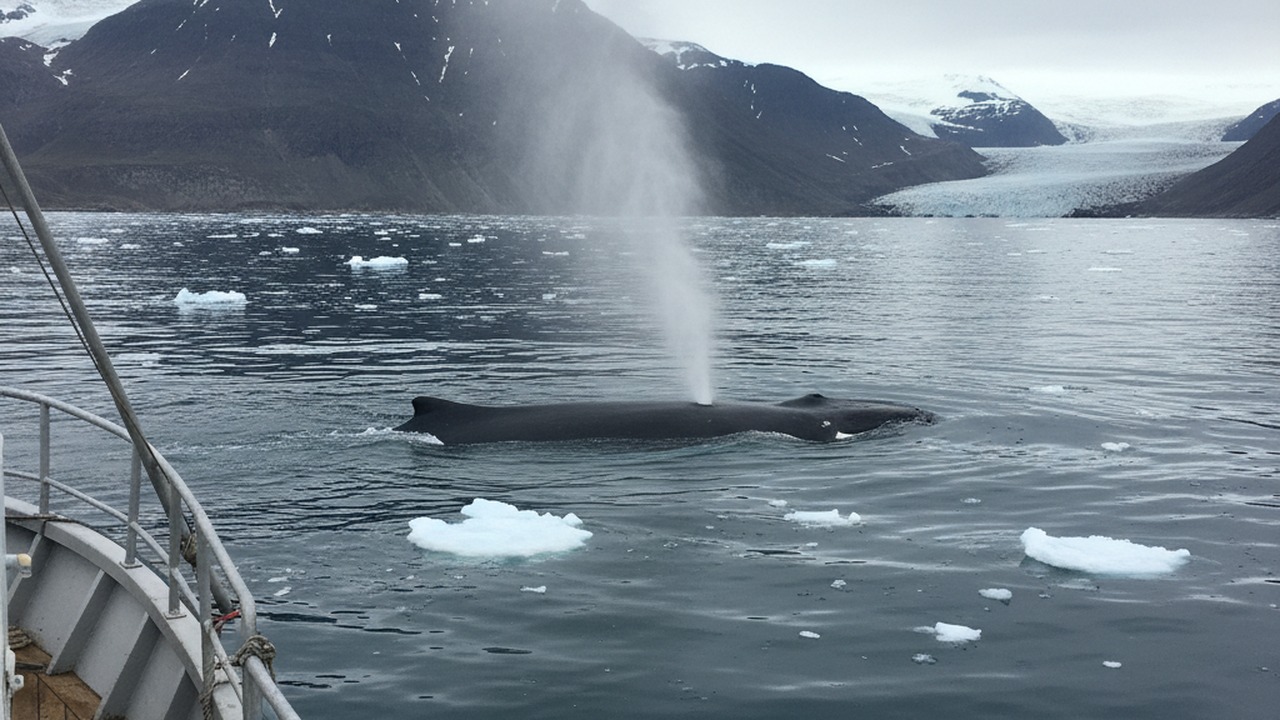
For most of the 20th century, the fjords of Northeast Greenland were sealed shut by ice for much of the year, off-limits to anything that needed open water to breathe and feed. That is no longer true.
Researchers tracking the region for more than three decades have now documented hundreds of the planet’s largest animals, fin whales, humpback whales, and occasionally blue whales, feeding in waters that were once impassable pack ice through the summer months.
A coastline that used to be closed
East Greenland’s continental shelf has historically been one of the most ice-choked stretches of the Arctic, fed by ice exported out of the central Arctic Ocean along the East Greenland Current. Ships and whales alike simply could not get in.
Long-term monitoring programs run out of the Greenland Institute of Natural Resources, along with aerial and vessel surveys dating back to the 1980s, have tracked how that has changed. As summer sea ice extent has declined sharply across the wider Arctic over the past four decades, a trend documented repeatedly in satellite records analyzed by the National Snow and Ice Data Center, the fjords and shelf waters off East Greenland have opened up for longer stretches each year.
That is exactly the kind of habitat large baleen whales need. They do not hunt individual prey the way a seal or an orca does.
Instead, they lunge through dense swarms of krill and small schooling fish, engulfing tons of water and prey in a single mouthful. That strategy only works in open water, which is why sea ice has functioned as a hard boundary on where these animals can go, regardless of how much food might be sitting just behind it.
What the survey data shows
The pattern researchers describe is not a handful of stray sightings. It is a sustained increase in whale presence tracked across repeated survey seasons, with animals now regularly recorded well up the East Greenland coast in areas that produced few or no sightings in earlier decades of the same monitoring program.
Fin whales, the second-largest animal on Earth after the blue whale, make up a large share of the sightings. Humpback whales, known for the long migrations that take them from tropical breeding grounds to polar feeding areas each year, have also been showing up in greater numbers.
Both species depend on Arctic and sub-Arctic waters as their primary feeding grounds, building the fat reserves each summer that carry them through months of migration and, for humpbacks, a winter breeding season where they barely eat at all.
Researchers who study Arctic marine mammals, including scientists affiliated with the University of Washington’s Polar Science Center, have separately documented similar range shifts among bowhead whales and narwhals as ice cover has receded across the wider Greenland and Baffin Bay region. The East Greenland findings fit a broader pattern: as ice retreats, whale distribution follows it.
Why an ice-free fjord is not automatically good news
It is tempting to read a rise in whale sightings as a straightforward win for the animals. More open water, more feeding time, more whales.
But researchers studying the shift are careful not to frame it that way. New habitat access does not mean new food is guaranteed to be there, and it does not mean the ecosystem underneath the water is stable.
Sea ice is not just a barrier to ship and whale traffic. It is also a foundation for the Arctic food web, hosting the algae blooms that feed copepods and krill, which in turn support the fish and whales further up the chain.
Losing that ice too quickly can disrupt the timing and location of those blooms even as it opens more physical space for whales to move into. A fjord with open water but a collapsed prey base is not actually good habitat, whatever it looks like from a boat deck.
There is also the question of what whales moving into new areas means for ship traffic. As Arctic shipping lanes open alongside the retreating ice, more vessels are transiting waters that whales are now using as feeding grounds, raising the risk of ship strikes in areas that had essentially zero vessel traffic a generation ago.
What this tells scientists about the pace of change
Whales are useful indicators precisely because they are so large and so easy to count relative to smaller Arctic species. A change in fin whale distribution is a visible, countable signal of an ecosystem shift that is otherwise playing out mostly underwater and out of sight.
The East Greenland data adds to a growing body of evidence that Arctic marine ecosystems are not just warming gradually. They are reorganizing, with species tracking habitat as it shifts north and opens up on timescales of years rather than centuries.
That reorganization does not stop at whales. Fish stocks, seabird colonies, and the Indigenous and local communities that depend on predictable ice and wildlife patterns for hunting and fishing are all contending with the same underlying shift.
The bigger picture
Hundreds of the world’s largest animals feeding in water that used to be locked under ice is a striking image, and it is easy to see why it draws attention. But the more useful way to read it is as a symptom, not a story about resilience.
The whales did not adapt to a changing Arctic so much as the Arctic changed enough to let them in. What happens next, whether the prey base holds, whether shipping lanes and feeding grounds start to overlap, and how fast the ice keeps retreating, will determine whether this counts as new opportunity or the leading edge of a much bigger disruption.